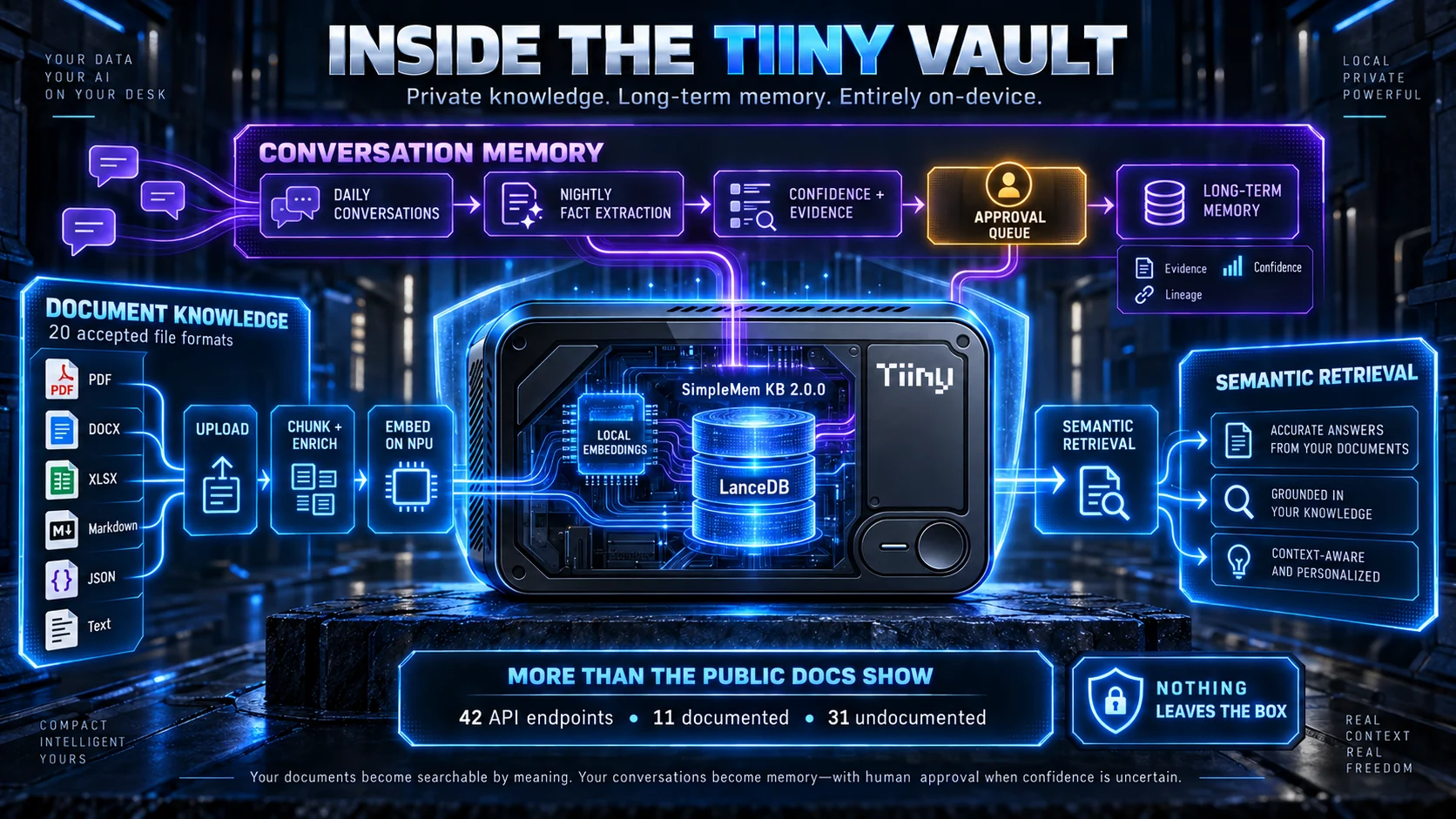
If you have poked at the Vault and were not sure what it actually does, this is the plain version.
It is two things under one name. The first is a document store you can search by meaning: you drop files in, the device chunks them, an embedding model on the NPU turns them into vectors, and they land in a local database. The second is a memory engine: it reads the conversations you have with the box, and overnight it pulls out facts about you and your work. Anything it is not confident about waits in a queue for you to approve. Nothing leaves the device at any point.
Four things that trip people up, learned the hard way:
Uploaded is not indexed. They are two separate steps, and a file that is only uploaded returns nothing from search and gives you no warning at all.
Indexing needs an embedding model loaded. With none loaded there is nothing for it to run on, so check that first when a file will not index.
The file types are not documented anywhere, but the service will tell you itself. Hand it something it refuses and it prints the whole allowlist: txt, md, markdown, log, html, htm, xml, yaml, yml, ini, cfg, conf, toml, csv, json, pdf, doc, docx, xls, xlsx. So PDF, Word and Excel are in, PowerPoint is not, and slides have to go through PDF first.
HTML goes in with its tags. A web page you saved will retrieve better if you convert it to text or Markdown before you add it.
I wrote the whole thing up, including how a retrieval result is actually shaped, the nightly memory pass, and the 42 endpoints the service has against the 11 the reference documents. Everything in it is either measured on a device or quoted from the service's own OpenAPI spec, and it says which is which.
https://artifacts.semfreak.dev/a/tiiny/tiiny-vault-a9df99ba/
If something in there does not match what your box does, tell me and I will fix the page.

This is very cool highly recommend.